
Table of Contents:
Arriving in Rovinj: The Ideal Gateway to Croatia’s West Coast
Rovinj is a smart first stop for a Croatian coast journey. It gives you a gentle start before the faster pace of ferries, island crossings, and historic cities farther south. The town is compact, easy to explore on foot, and well placed for short trips across western Istria.
There is no airport in Rovinj, so choose your arrival route with care. Rijeka Airport and Trieste Airport are both practical options, with the final journey usually taking about 90 minutes by road. A third option combines a city break with a sea crossing: fly to Venice, spend a few hours there, then take a seasonal ferry to Rovinj. The crossing takes around three hours and may stop at Poreč. Always check the current timetable, as services can change with the season.
Keep a time buffer between your flight and ferry. Adriatic sailings depend on weather, port procedures, and seasonal demand. If you arrive through Venice, store large bags before exploring the city and return to the terminal well before boarding. Ferry operators often require check-in ahead of departure, especially in summer.
Rovinj also works well for travelers who prefer not to drive. Local buses connect it with nearby Istrian towns, while taxis and pre-booked transfers cover the airport links. A rental car offers more freedom for inland villages and remote coves, but parking near the old town can be limited. For a short stay, a car may become more burden than benefit.
Plan your first evening around the waterfront rather than a packed sightseeing list. The harbor is close to many central accommodations, and the old town rises behind it on a small peninsula. After a long travel day, this layout matters: you can reach restaurants, viewpoints, and quiet lanes without another transfer.
For the smoothest arrival, use this simple plan:
- Choose the airport or ferry route before booking accommodation.
- Allow extra time for seasonal traffic and port check-in.
- Confirm luggage rules and sailing times directly with the operator.
- Book a transfer if arriving late or traveling with heavy bags.
- Stay within walking distance of the harbor if Rovinj is your base for one night.
From here, the journey can move south toward Split, Korčula, and Dubrovnik. Rovinj sets the tone: relaxed, coastal, and pleasantly unhurried before the grander drama of Dalmatia begins.
Rovinj’s Colorful Old Town, Harbor, and Venetian Charm
Rovinj’s old town rewards slow walking. Begin near Balbi’s Arch, the historic entrance to the peninsula, then follow Grisia Street uphill. Its stone surface, narrow lanes, and small galleries create a route that feels more like a lived-in quarter than an open-air museum. Look above shopfronts for carved details, faded shutters, and traces of Venetian design.
The town’s strongest landmark is St. Euphemia’s Church, which crowns the highest point of the old town. Its bell tower rises about 60 metres and echoes the form of Venice’s San Marco campanile. The climb is steep and the wooden steps can feel uneven, but the view from the top reaches across the red roofs, the harbor, and the nearby islands. On a clear day, that panorama explains Rovinj better than any postcard.
Set aside time for the small heritage collections around the center. The Rovinj Heritage Museum, housed in the Baroque Califfi Palace, presents local art and history. The Batana House Museum focuses on the traditional flat-bottomed fishing boat known as the batana. This is a useful stop for understanding how fishing shaped the town’s waterfront culture, not just its appearance.
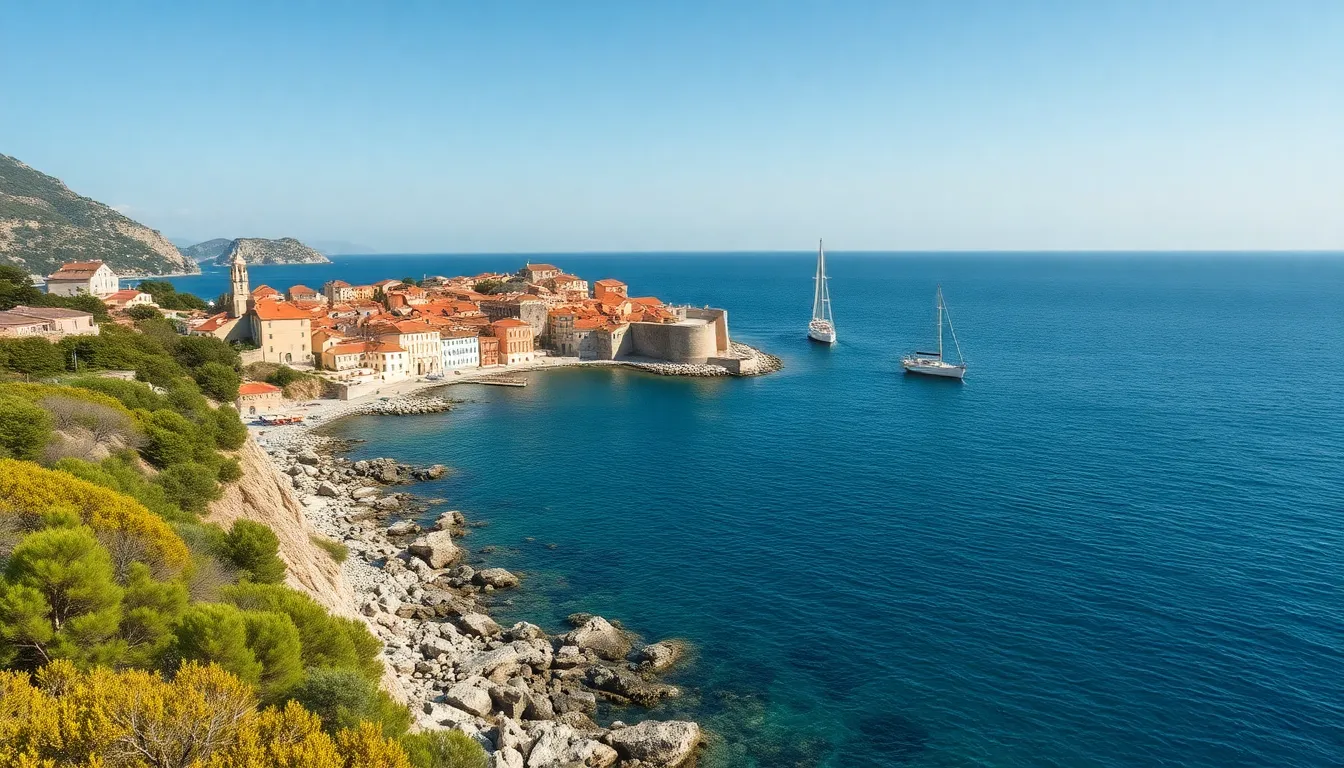
At the harbor, watch the town change through the day. Fishing boats return in the morning, while waterfront cafés become livelier later on. The promenade beside the old town offers open views without demanding a long hike. For photographs, the best angles often come from the opposite side of the harbor, where the peninsula appears as a dense cluster of warm-colored façades.
Rovinj’s Venetian character is visible in its urban details rather than in one single monument. Tall houses stand close together because land inside the old peninsula was limited. Narrow passages helped shade the streets, while sea-facing windows connected homes with trade and fishing. The result is compact, vertical, and slightly theatrical.
- Walk through Balbi’s Arch before the main daytime crowds arrive.
- Follow Grisia Street to St. Euphemia’s Church.
- Visit the Heritage Museum or Batana House during the hotter part of the day.
- Use the harbor promenade for broad views of the old town.
- Wear shoes with a firm grip on the polished stone streets.
For a quieter finish, cross toward Golden Cape Forest Park. Its wooded paths lead to rocky swimming spots and shaded coastal viewpoints. The park is not a substitute for the old town; it adds a different rhythm. After stone alleys and church bells, pine scent and open water make the evening feel wonderfully unbuttoned.
Best Croatian West Coast Destinations at a Glance
| Destination | Best For | Key Highlights | Ideal Stay | Travel Considerations |
|---|---|---|---|---|
| Rovinj | Old-town atmosphere and gentle coastal exploration | St. Euphemia’s Church, Balbi’s Arch, harbor promenade, Golden Cape Forest Park | 1–2 days | Compact and walkable; parking near the old town can be limited |
| Opatija and Volosko | Historic villas, promenades, and seafood | Lungomare, Austro-Hungarian architecture, waterfront restaurants, Kvarner prawns | 1 day | Coastal paths may include steps and uneven pavement |
| Premantura and Cape Kamenjak | Wild nature and outdoor activities | Rocky coves, pine woodland, cycling routes, kayaking, Safari Bar | 1 day | Limited shade; bring water and sturdy footwear |
| Split | Ancient history and lively city life | Diocletian’s Palace, Peristyle, Riva, Cathedral of Saint Domnius, Marjan | 1–2 days | Busy in summer; explore major sights early in the day |
| Hvar | Nightlife, dining, and historic island scenery | Hvar Town fortress, Venetian architecture, lavender fields, beaches | 2 days | Accommodation and catamaran seats should be booked early |
| Brač | Beaches and outdoor activities | Zlatni Rat, Vidova Gora, cycling, hiking, stone-cutting traditions | 1–2 days | Popular beaches can become crowded during peak season |
| Vis | Remote atmosphere and traditional island culture | Komiža, Vis Town, vineyards, fishing heritage, boat trips | 2–3 days | Less developed and slower to reach; flexible planning is useful |
| Korčula and Pelješac | Wine, local food, and historic stone towns | Korčula Old Town, Pošip, Grk, Dingač, Ston walls, Mali Ston oysters | 2 days | Wine tours are easier with a pre-booked transfer |
| Mljet | Quiet beaches and protected nature | Mljet National Park, saltwater lakes, St. Mary’s Island, cycling trails | 1–2 days | Services are limited inside the park; check seasonal boat times |
| Dubrovnik | Historic landmarks and dramatic coastal views | City walls, Stradun, Rector’s Palace, Mount Srđ, Lokrum Island | 2 days | Visit the walls early to avoid heat and crowds |
Opatija and Volosko: Elegant Villas and Fresh Adriatic Seafood
Opatija presents Croatia’s west coast in a more polished key. Its seafront is lined with Austro-Hungarian villas, manicured gardens, and grand hotels built when the town became a fashionable winter resort in the nineteenth century. The old spa tradition still shapes the atmosphere: broad promenades, sheltered parks, and a slower daily rhythm invite you to look around rather than rush from sight to sight.
Follow the Lungomare, a coastal path that links Opatija with nearby villages. The route offers changing views of wooded slopes, rocky inlets, and the Kvarner Gulf. It is not a demanding hike, but sections include steps and uneven pavement. Allow extra time for photo stops, especially near the Maiden with the Seagull statue, one of the area’s most recognisable viewpoints.
Volosko feels smaller and more intimate. Its compact harbor is framed by stone houses, moored boats, and a curved waterfront path. The village has a strong fishing identity, which is reflected in its restaurants. Here, the setting is part of the meal: tables sit close to the water, and the menu often follows the morning catch.
Look for regional dishes such as grilled scampi, squid, Adriatic cuttlefish, and fish prepared simply with olive oil, garlic, and herbs. Local kitchens also use kvarnerski škampi, prized prawns from the Kvarner Gulf. Their delicate flavor needs little decoration. Ask whether seafood is wild-caught or farmed, and check the price of market-weight items before ordering.
For a balanced visit, combine architecture with a long lunch. Start in Opatija’s parks, continue along the coastal promenade, then end in Volosko when the light softens. The two places are close enough to connect on foot, yet distinct enough to deserve separate attention. Opatija supplies the elegance; Volosko brings the salt, smoke, and lively kitchen talk.
- Choose the Lungomare for an easy coastal walk with frequent viewpoints.
- Visit early or late in the day when the promenade feels less busy.
- Reserve a waterfront table in Volosko during the high season.
- Ask about the day’s catch and the final price before ordering by weight.
- Bring a light jacket: the Kvarner coast can feel breezy after sunset.
Premantura and Cape Kamenjak: Wild Nature by the Sea
Premantura sits at the southern tip of the Istrian peninsula, where low pine woodland meets a rugged coastline. It is the main gateway to Cape Kamenjak, a protected landscape known for clear coves, pale limestone, and exposed headlands. The scenery feels rawer here than in Croatia’s polished resort towns. There are few grand buildings, little shade along the outer trails, and plenty of wind-shaped vegetation.
The protected area covers a narrow peninsula with more than 30 kilometres of coastline. Its eastern shore is often calmer, while the western side faces open sea and can feel wilder. Small bays invite swimming, but most have stone or gravel entries rather than soft sand. Bring water shoes, especially if you plan to enter from the rocks.
One of the area’s most distinctive sights is the Safari Bar, a quirky open-air beach bar built into the vegetation near the southern end. Its rough timber structures, rope bridges, and shaded corners suit the setting perfectly. It is informal rather than refined, so expect simple drinks and a playful atmosphere instead of table service and polished design.
Cape Kamenjak is also a strong choice for active travelers. Hire a bicycle in Premantura, walk the coastal tracks, or join a sea-kayaking trip to explore caves and offshore inlets. The routes are not always smooth. Limestone can be sharp, and summer heat builds quickly on the exposed western side.
Protecting this fragile coast takes a little discipline. Stay on marked tracks, carry all rubbish out, and avoid picking plants or disturbing wildlife. Fires are especially dangerous in dry weather. Entry rules and vehicle charges can vary, so check the official park information before driving in. A bicycle or early shuttle can be more practical than searching for a parking space at midday.
- Start early to find cooler paths and easier parking.
- Pack at least one litre of drinking water per person for a longer outing.
- Use reef-safe sunscreen and wear sturdy footwear.
- Choose sheltered coves when wind makes the open coast rough.
- Leave fragile rock pools, plants, and marine life untouched.
Premantura works best when treated as a nature day, not a checklist of beaches. Pick one walking or cycling route, allow time for a swim, and stay until the late light reaches the limestone. The peninsula’s appeal lies in its simplicity: sea, scrub, rock, and a horizon that seems to keep going.
From Istria to Dalmatia: Planning the Seven-Day Coastal Route
A seven-day route from Istria to southern Dalmatia works best when you treat travel time as part of the trip. The distance looks modest on a map, yet the coast bends around mountains, bays, and ferry ports. The most efficient plan uses short stays in the north, then longer stops once you reach the island section.
Use Rovinj as the northern anchor, then move south through Split before choosing one island base and finishing in Dubrovnik. This avoids packing every day with a new check-in. It also leaves room for delays, swimming stops, and the occasional long lunch—important details on an Adriatic route.
- Days 1–2: Rovinj, with time for the old town and one nearby nature outing.
- Day 3: Transfer south to Split; keep the evening free for arrival and a first walk.
- Days 4–5: Explore one island, such as Hvar, Brač, Vis, or Korčula.
- Day 6: Continue toward the Dubrovnik area, using the Pelješac corridor or a coastal ferry where schedules fit.
- Day 7: Dubrovnik, with enough time for the historic center and a final sea view.
Do not treat every island as interchangeable. Hvar suits travelers who want lively evenings and a broad choice of restaurants. Brač is practical for beaches and outdoor activities, while Vis rewards visitors who prefer a slower, more remote atmosphere. Korčula works especially well for a mix of stone-built heritage, wine country, and a manageable island stay.
Transport planning needs a little realism. Coastal roads can slow down in July and August, particularly near Split and popular beach towns. Catamarans are fast but less flexible with luggage and weather. Car ferries offer more freedom, yet they require queueing at busy ports. Check the current sailing calendar through the official operator before fixing hotel dates, because seasonal routes are not always daily.
The route becomes easier if you separate fixed bookings from flexible days. Reserve the long transfer, island accommodation, and final-night stay first. Keep minor excursions open until you know the wind, sea conditions, and your own energy. This small change prevents a beautiful holiday from turning into a timetable exercise.
For luggage, choose one compact case or a soft travel bag. Cobblestones, gangways, and small guesthouses rarely reward oversized wheels. Keep swimwear, medication, documents, and a light layer in a day bag so a ferry crossing or early check-in does not disrupt the day.
A southbound journey also has a practical advantage: finishing in Dubrovnik gives you a clear departure point with an international airport. If flights are expensive, compare open-jaw tickets with a return from Zagreb or Venice, but include the final ground transfer in the total cost. The cheapest flight is not always the cheapest route once time and transport are added.
Split: Ancient History and Lively Waterfront Views
Split is where Croatia’s past becomes part of the daily street scene. The historic center grew inside the Palace of Roman emperor Diocletian, built in the early fourth century. Rather than standing apart as a silent monument, the complex still contains homes, cafés, shops, courtyards, and narrow lanes. That unusual mix makes Split feel less like an archaeological site and more like a city living inside its own history.
Start at the Golden Gate, then walk south through the palace streets toward the Peristyle. The central square is framed by ancient columns and later stonework, showing how Roman, medieval, Renaissance, and modern layers overlap. At the nearby Vestibule, the circular structure once formed part of the imperial entrance route. Its acoustics are remarkable; even a quiet voice can carry across the dome.
Climb the bell tower of Cathedral of Saint Domnius for a close view of Split’s dense rooftops and harbor. The cathedral incorporates Diocletian’s former mausoleum, making it one of the clearest examples of architectural reuse on the Adriatic. The stairs are narrow and open in places, so visitors who dislike heights may prefer the lower-level treasury and surrounding palace streets.
For context beyond the palace, visit the Archaeological Museum or the Gallery of Fine Arts. The first connects Split with the wider Roman and pre-Roman history of Dalmatia. The second offers a quieter indoor break, with Croatian art from different periods. Choose one rather than trying to absorb every museum in a single afternoon; Split is better when explored with some breathing space.
The Riva, Split’s seafront promenade, changes character after sunset. Palm trees, cafés, ferries, and passing residents create a lively urban edge. It is not the place for an empty-horizon experience. Instead, watch the harbor traffic, then continue toward the western side of the peninsula for a calmer walk through Marjan Forest Park.
Marjan adds shade, viewpoints, and a welcome break from stone streets. Paths rise through pine woodland toward small chapels and lookout points above the city. Wear suitable footwear and carry water, especially in summer. The climb is moderate, but the heat can make it feel less so.
- Enter the palace early for clearer views of the Peristyle.
- Use the city’s central lanes to find smaller courtyards beyond the main route.
- Allow time for the cathedral tower only if you are comfortable with steep, narrow stairs.
- Walk the Riva in the evening, when local life becomes more visible.
- Choose Marjan for a greener afternoon away from the busiest streets.
Split suits travelers who want history without leaving city life behind. Roman walls frame morning coffee, laundry hangs above ancient passages, and the harbor keeps the scene moving. That contrast is the city’s real strength: monumental, noisy, imperfect, and very much alive.
Hvar, Brač, and Vis: Choosing the Right Adriatic Island
Choosing between Hvar, Brač, and Vis depends less on finding the “best” island and more on matching the island to your available time. Each has a different travel rhythm, landscape, and level of development. For a seven-day route, choose one as a base rather than trying to collect all three.
Hvar is the easiest choice for travelers who want a strong mix of culture, dining, swimming, and evening activity. Hvar Town has a historic fortress above the harbor, Renaissance architecture, and a busy social scene in summer. The island’s interior is quieter, with lavender fields, dry-stone walls, and small villages. Stay in Hvar Town for convenience; choose Stari Grad for a calmer base with deeper historical character.
Brač suits visitors who want outdoor time and a more practical island experience. Its most famous beach, Zlatni Rat near Bol, changes shape with wind and currents. It is striking, but it can become crowded in peak season. For a broader view of the island, explore the limestone summit of Vidova Gora, visit the stone-cutting village of Pučišća, or plan a day around local olive oil and wine.
Vis feels more remote because it remained closed to foreign visitors until 1989. That history helped preserve a slower atmosphere and a strong local identity. Komiža, on the western coast, is a good base for fishing traditions, small beaches, and boat excursions. Vis Town offers easier transport links and access to archaeological sites, vineyards, and inland villages.
Boat trips to the Blue Cave on nearby Biševo are popular from Vis and other islands. Conditions matter: access can be restricted when the sea is rough, and the best light usually appears in the morning. Treat the cave as a possible highlight, not a guaranteed attraction. Nature, as usual, does not read the brochure.
- Choose Hvar for nightlife, historic streets, and the widest choice of accommodation.
- Choose Brač for beaches, hiking, cycling, and easy access from the mainland.
- Choose Vis for a slower pace, local food, and a less polished island feel.
- Book catamaran seats and peak-season rooms well ahead.
- Keep boat excursions flexible until the weather forecast is reliable.
For this itinerary, Hvar offers the simplest first island stop after Split, while Brač is often better for travelers who want less complicated logistics. Vis rewards an extra night or two. If you have only one full island day, choose based on experience rather than distance: Hvar for energy, Brač for scenery and movement, Vis for atmosphere.
Korčula and Pelješac: Vineyards, Stone Streets, and Local Flavors
Korčula is a strong choice for travelers who want heritage, food, and a slower island pace in one compact stop. Its old town is set on a small peninsula, with stone lanes arranged like a fishbone. This layout once helped control sea breezes and movement through the settlement. Today, it makes the center easy to explore without a rigid sightseeing plan.
Begin at St. Mark’s Cathedral and follow the narrow streets toward the old defensive walls. The town’s architecture reflects centuries of Venetian influence, but local limestone gives it a distinct Dalmatian character. Visit the Marco Polo Interpretation Centre if you want a modern, multimedia look at the long-standing local association with the explorer. Treat the Marco Polo connection as tradition rather than settled historical proof; the distinction matters.
Korčula’s countryside adds a different layer. Vineyards cover parts of the island, producing the white wine Pošip, one of Croatia’s best-known indigenous varieties. Look for it served with grilled fish, octopus salad, or fresh cheese. Local restaurants may also offer Grk, a rare white grape grown mainly around Lumbarda. Its dry, slightly bitter finish pairs well with shellfish and salty appetizers.
Across the channel, the Pelješac Peninsula is one of southern Croatia’s key wine regions. Its steep, sun-facing slopes produce Dingač and Postup, powerful red wines made from Plavac Mali grapes. The roads between Ston, Trstenik, and Orebić pass through dramatic vineyard country. Small tasting rooms often provide a more useful introduction than a formal tour, especially when the producer explains the terrain and harvest by hand.
Stop in Ston for its defensive walls and historic saltworks. The walls climb the hillside above town and are often called the “European Great Wall,” though the nickname is more dramatic than precise. The walk is steep and exposed, so go early or near sunset. Ston is also known for oysters from nearby Mali Ston Bay, where brackish water and traditional cultivation create a distinctive mineral flavor.
- Stay in Korčula Town for walkable heritage and evening dining.
- Choose Lumbarda for vineyards, beaches, and a quieter rural setting.
- Pair Pošip or Grk with seafood rather than heavy dishes.
- Visit Pelješac wineries by pre-booked transfer if you plan to taste several wines.
- Carry water for the Ston walls, particularly between June and September.
Korčula and Pelješac work especially well together because they offer contrast without excess travel: island lanes and vineyard slopes, elegant whites and robust reds, open-water views and old fortifications. Give the region at least two nights if wine and food matter to your trip. Rushing through it would be a shame.
Mljet: Quiet Beaches and Protected Island Landscapes
Mljet is the island to choose when you want nature to set the pace. Much of its western section forms part of Mljet National Park, a protected landscape of Aleppo pine forest, saltwater lakes, rocky shores, and quiet paths. The park includes Veliko Jezero and Malo Jezero, two connected marine lakes whose calm surfaces can feel far removed from the busier mainland.
Start in Pomena or Polаče, the two main access points. Pomena sits close to the national park entrance and suits visitors who want the shortest route to the lakes. Polače has a more sheltered harbor and important Roman ruins, including the remains of a fourth-century palace complex. Neither village is large, so book accommodation early if you plan to stay overnight.
Inside the park, rent a bicycle or follow the marked walking trails around the lakes. The route is mostly gentle, although heat and uneven ground can slow you down. At Veliko Jezero, a small boat carries visitors to St. Mary’s Island, home to a former Benedictine monastery and church. Boat schedules are seasonal, and service may pause in poor weather, so avoid building your entire day around one departure.
The lakes are suitable for swimming in designated areas, but they are not ordinary freshwater pools. They connect with the sea, and their temperature and salinity change with tides and weather. Bring a towel, drinking water, and a dry bag for valuables. There are fewer services inside the protected area than in a resort town, which is part of the appeal—and occasionally a small inconvenience.
Mljet also offers darker skies than many developed coastal destinations. If you stay overnight, walk away from the harbor lights after sunset and look for clear views across the park. Keep artificial light low and follow local guidance, since the island’s forests and wildlife benefit from a quiet night environment.
- Use Pomena for quick access to the national park.
- Choose Polače for Roman remains and a sheltered harbor setting.
- Check park boat times before setting out for St. Mary’s Island.
- Carry water, sun protection, and footwear suitable for rocky trails.
- Swim only where permitted and take all rubbish back with you.
Mljet is not the place for constant entertainment or a packed list of attractions. Its reward is subtler: pine shade, still water, old stone, and long stretches where the loudest sound may be a cicada. Add it to the route when restoration matters as much as sightseeing.
Dubrovnik: The Dramatic Finale on Croatia’s Southern Coast
Dubrovnik makes a powerful final stop because its historic center rises directly from the sea. Massive stone walls surround a dense urban core of monasteries, palaces, churches, and narrow lanes. The city is compact, but its history is not: Dubrovnik developed as the independent maritime Republic of Ragusa and built its wealth through trade and diplomacy.
Walk the full circuit of the city walls early in the day. The route is about two kilometres long and includes many stairs, with little shade on exposed sections. From the ramparts, you can see the terracotta roofs, Fort Lovrijenac, Lokrum Island, and the Adriatic horizon. Carry water and avoid the hottest afternoon hours. A single walk gives you a far better sense of the city’s layout than repeated turns through the crowded center.
Inside the walls, follow the polished limestone of Stradun, then look beyond the main street. Rector’s Palace, the Franciscan Monastery, and the Dominican Monastery each reveal a different part of Dubrovnik’s political, religious, and cultural life. The Franciscan complex also preserves one of Europe’s oldest functioning pharmacies, traditionally dated to 1317.
For a broader historical view, visit Fort Lovrijenac, built on a rock west of the old town. Its elevated position protected the city from attack and now provides striking views back toward the walls. The fort’s entrance bears the Latin phrase “Non bene pro toto libertas venditur auro”—freedom is not sold for all the gold in the world. It remains a fitting symbol of Dubrovnik’s civic identity.
When the old town becomes busy, take the cable car up Mount Srđ. The summit overlooks Dubrovnik, the Elaphiti Islands, and the coastline north and south. The Imperial Fortress at the top houses a museum about the 1991–1995 Croatian War of Independence. This visit adds difficult but essential context to the postcard landscape.
For a quieter final swim, take a boat to Lokrum or use the rocky shoreline near Pile Gate. Lokrum’s botanical garden, monastery ruins, and shaded paths make it more than a beach escape. Follow signs, respect protected areas, and leave enough time for the return boat, since late services may be less frequent.
- Walk the city walls before the main day-trip arrivals.
- Buy tickets from official city channels and check access conditions before visiting.
- Use Mount Srđ for panoramic views and recent-history context.
- Explore side streets away from Stradun for quieter courtyards and local shops.
- Keep your final evening flexible if you need to reach Dubrovnik Airport the next day.
Dubrovnik is visually grand, yet its real impact comes from the meeting of beauty and memory. Fortifications, sea routes, war history, and everyday life occupy the same small space. As the last chapter of a coast-to-coast journey, it leaves you with more than a dramatic view: it gives the route a sense of place, scale, and closure.
Ferries, Flights, and Travel Tips for a Smooth Journey
Reliable transport planning makes a seven-day Croatian coast trip much easier. Timetables change by season, and the same route may have several names across booking sites. Check the official airport, ferry, bus, and port websites before paying. Save each confirmation offline; mobile coverage can fade during crossings or in inland valleys.
Use ferries for island-to-island travel, but do not assume every sailing accepts cars. Fast catamarans usually carry passengers only, while vehicle ferries take longer and may require an earlier arrival. In July and August, arrive at a car-ferry port well before departure. A reservation may secure a place on a sailing, but it does not always remove the need to join the loading queue.
For bus travel, compare the departure station with your accommodation rather than relying only on the town name. Larger cities can have several stops, and some island services leave from a port outside the historic center. Keep small cash and a card available: local transport systems do not all use the same payment method.
Driving can be useful for Istrian villages and inland wine areas, but it becomes less convenient in old towns and on islands. Check rental contracts for cross-border travel, ferry use, and one-way drop-off fees. Croatia uses the euro, introduced in 2023, but payment terminals and small vendors may still differ in their card policies.
Weather is a practical factor, not just a forecast detail. Strong bura winds can disrupt ferry traffic, while summer storms may delay road journeys. Build a backup plan around the nearest mainland town, and avoid scheduling an international flight immediately after an island crossing. One spare night near your departure airport can protect the whole trip.
Keep these items easy to reach:
- Passport or identity card, plus a digital backup.
- Travel insurance details and emergency contacts.
- Accommodation addresses in Croatian and English.
- Refillable water bottle, sun protection, and a light rain layer.
- Portable charger for maps, tickets, and transport alerts.
For current safety notices, entry rules, severe-weather warnings, opening hours, and seasonal access, consult your government’s travel advice, Croatia’s official tourism and transport channels, park authorities, and the operators themselves shortly before departure. Rules and schedules can change after publication. A flexible plan, clear documents, and realistic transfer times will do more for a smooth journey than squeezing in one extra destination.
Conclusion: Build Your Croatian Coast Adventure Around Rovinj, Islands, and Dubrovnik
A memorable Croatian coast trip is not measured by how many ports you collect. It is shaped by contrast: Istrian atmosphere, Dalmatian history, island landscapes, and the final sweep of the southern coast. The strongest plan gives each place a clear role instead of forcing every attraction into one hurried week.
Use Rovinj as the gentle opening, the islands as the flexible middle, and Dubrovnik as the visual and historical finale. That structure creates a natural change of pace. It also lets you adjust the middle days to your interests: food and wine, swimming, walking, archaeology, or simple time beside the water.
Before booking, decide what you value most. A traveler who loves galleries and regional cooking may prefer longer stops in historic towns. Someone seeking quiet coves should reduce city time. Families may benefit from fewer accommodation changes, while photographers may welcome early departures and slower evenings. There is no single perfect Croatian coast route; there is only a route that fits the way you travel.
- Choose fewer bases and explore each one with purpose.
- Match island time to your main interest, not to its popularity.
- Leave room for weather, rest, and spontaneous local discoveries.
- Support small museums, family-run restaurants, and responsible nature sites.
- Review opening hours and seasonal access shortly before departure.
The coast is at its most rewarding when you allow room for ordinary moments: a market purchase, a quiet swim, a village road, or an unplanned coffee with a sea view. Those details connect the celebrated landmarks into a real journey.
Build the trip around movement, but do not let movement dominate it. Start with Rovinj’s character, choose your island experience carefully, and reserve enough energy for Dubrovnik’s scale and complexity. The result is not merely a tour of Croatia’s west coast. It is a balanced passage from north to south, with enough structure to feel secure and enough freedom to feel like your own.
Frequently Asked Questions About Croatia’s West Coast
What are the best destinations on Croatia’s west coast?
Top destinations include Rovinj, Opatija, Volosko, Premantura and Cape Kamenjak, Split, Hvar, Brač, Vis, Korčula, Pelješac, Mljet, and Dubrovnik. Together, they offer historic towns, beaches, islands, nature reserves, vineyards, and Mediterranean cuisine.
How many days are needed to explore Croatia’s west coast?
Seven days are enough for a highlights route from Rovinj through Split and one Adriatic island to Dubrovnik. To explore several islands, wine regions, and national parks at a relaxed pace, plan for at least ten to fourteen days.
Which Croatian island should travelers choose?
Hvar is ideal for nightlife, dining, and historic scenery. Brač suits travelers seeking beaches and outdoor activities, while Vis offers a quieter and more traditional island atmosphere. Korčula is a good choice for historic streets, local food, and wine.
What is the best way to travel along Croatia’s coast?
Use ferries and catamarans for island connections, buses for major coastal cities, and a rental car for Istrian villages, remote coves, and wine regions. Check official schedules because services vary by season, weather, and route.
When is the best time to visit Croatia’s west coast?
Late spring and early autumn offer a good balance of warm weather, manageable crowds, and reliable sightseeing conditions. July and August are best for peak beach activity but are also the busiest months, with higher prices and greater demand for ferries and accommodation.