Table of Contents:
Alpine Architecture and Craftsmanship: Timber, Stone, and the Swiss Building Tradition
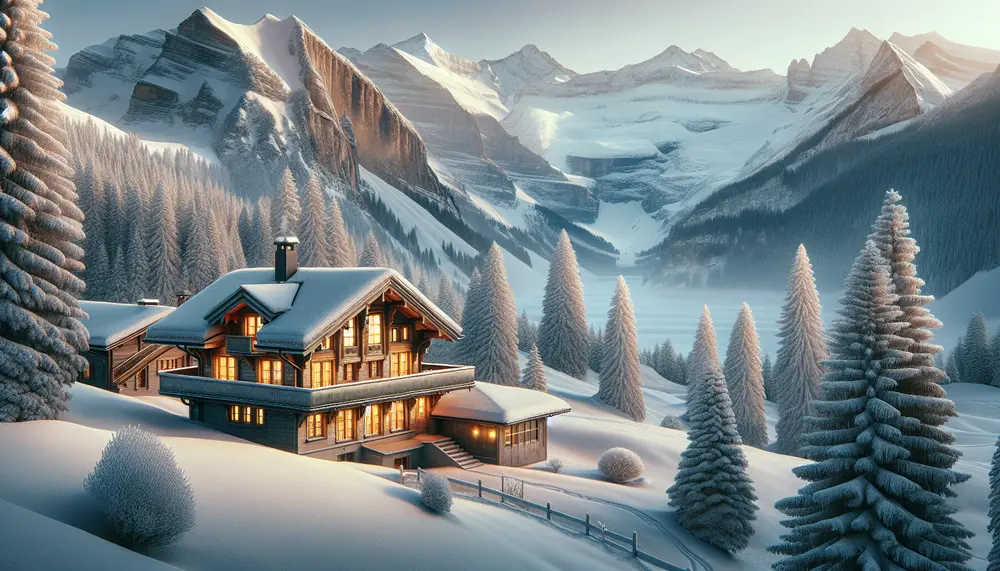
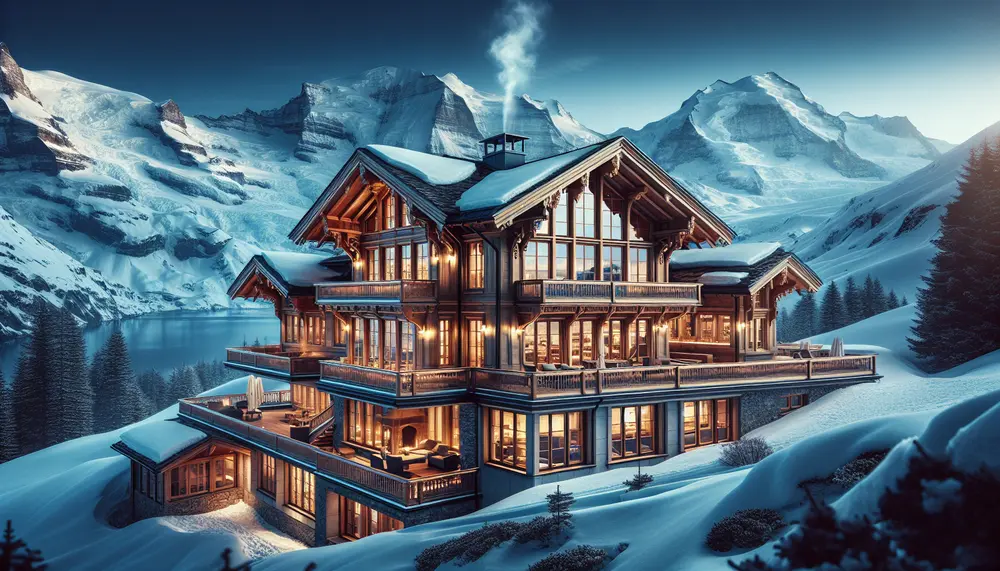
Swiss chalet architecture is not an aesthetic choice — it is an engineering response to one of the most demanding natural environments on earth. The classic Bernese Oberland chalet, with its wide-hipped roof, carved balconies, and horizontally stacked log construction, evolved over centuries to handle snow loads exceeding 400 kilograms per square meter, temperatures swinging 50°C between seasons, and the relentless expansion and contraction that destroys lesser structures within decades. Understanding this heritage is the foundation for evaluating any exclusive property in the Swiss Alps.
Timber as a Structural and Cultural Material
The dominant building material in traditional Swiss chalets is Arvenholz — Swiss stone pine (Pinus cembra) — harvested from elevations above 1,600 meters. This slow-growing wood, sometimes taking 200 years to reach usable dimensions, has an exceptionally tight grain structure that resists moisture penetration and remains dimensionally stable under alpine stress. A genuinely old Arve beam in a Valais farmhouse conversion carries material value alone that modern structural timber simply cannot replicate. When inspecting a heritage property, look for Blockbau construction: horizontally laid logs notched at the corners, which allows the structure to breathe and settle organically rather than fighting against thermal movement.
Regional variation is significant and often underestimated by buyers. The distinct construction languages across different cantons — from the stone-heavy Graubünden style to the elaborately decorated wooden facades of Appenzell — reflect local geology, climate, and trade history. A chalet in Pontresina will be built fundamentally differently from one in Gstaad or Verbier, and these differences affect everything from renovation costs to long-term maintenance requirements.
Stone, Foundation, and the Masonry Tradition
In regions with severe avalanche exposure, local builders developed the Rustico typology: structures built predominantly from granite or gneiss with walls reaching 60–90 centimeters in thickness. These buildings function as thermal masses, absorbing heat during the day and releasing it slowly through alpine nights. The mortar joints in historic stone construction were traditionally lime-based, allowing slight movement without cracking — a property that modern Portland cement repairs often damage irreparably. Any restoration work on a stone chalet should specify NHL 3.5 or NHL 5 hydraulic lime mortars to preserve this flexibility.
Skilled craftsmen — Zimmerleute for timber framing and Steinmetze for masonry — represent a genuine scarcity in the Swiss construction market. The canton of Bern alone has fewer than 120 registered specialists in traditional log construction, which directly affects both renovation timelines and costs. Premium restorations in Gstaad regularly run CHF 8,000–14,000 per square meter when traditional techniques and materials are non-negotiable.
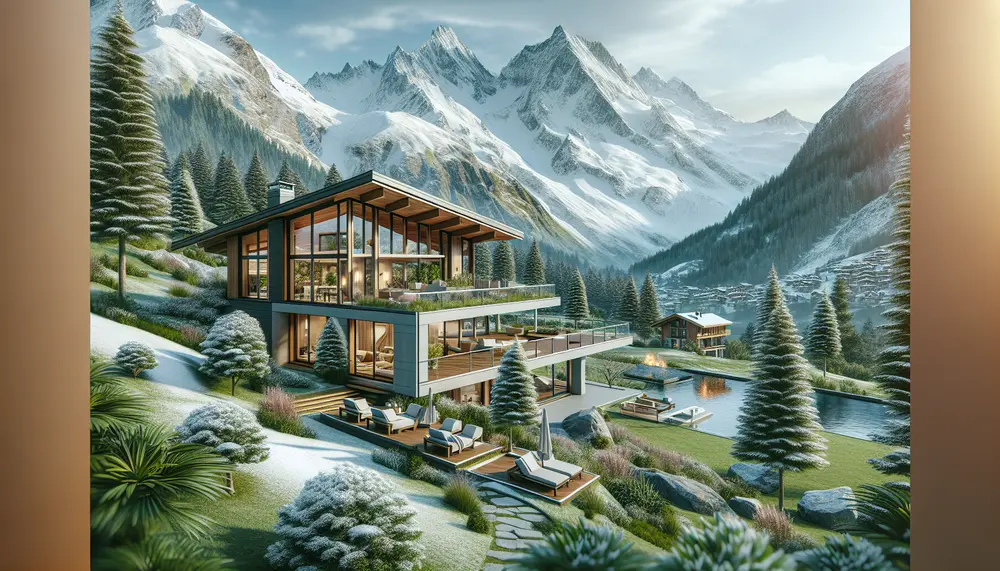
The interplay between heritage craftsmanship and contemporary expectations is where the most interesting design tension emerges. How architects and developers have transformed the traditional chalet into ultra-modern residences without sacrificing structural authenticity is one of the defining challenges — and selling points — of Switzerland's luxury property market today. The best projects treat historic fabric not as a constraint but as a primary asset, integrating radiant floor heating, triple-glazed fenestration, and smart home systems invisibly beneath hand-carved beams that have stood for 300 years.
- Arvenholz sourced above 1,600m altitude: check provenance documentation on premium restorations
- Roof pitch between 45° and 55° is standard for avalanche-zone chalets — deviations affect insurance classification
- Original Blockbau corner notching (Schwalbenschwanz or Schlösserblock) is a primary quality indicator in heritage properties
- Renovation permits in protected zones (Ortsbildschutz) require cantonal approval and can add 6–18 months to project timelines
The Evolution of Chalet Interiors: From Rustic Shelter to Five-Star Mountain Residence
The Swiss chalet as we know it today bears almost no resemblance to its 18th-century origins. What began as a functional shelter for Alpine herders — low ceilings, smoke-blackened timber, a single hearth for warmth and cooking — has undergone a transformation that accelerated dramatically in the 1990s and reached its current peak of sophistication in the last decade. The catalyst was not merely wealth, but a fundamental shift in how ultra-high-net-worth buyers define "comfort at altitude."
Through the 1970s and 1980s, even the most prestigious chalets in Verbier or Gstaad adhered to a recognizable formula: exposed wood everywhere, mounted antlers, heavy wool textiles, and perhaps a sauna tucked into the basement. The interiors were warm but visually cluttered, and the architecture rarely engaged seriously with the surrounding landscape. A chalet was a place to sleep after skiing, not a destination in itself.
The Design Revolution: When Architects Replaced Carpenters
The inflection point came when internationally recognized architecture firms began receiving commissions for Alpine residences. Studios like Stiffler & Partner in Verbier or the work of architects such as Rudy Ricciotti introduced a vocabulary that merged traditional materials — larch, stone, hand-hewn oak — with contemporary spatial logic. Floor plans opened up. Ceiling heights pushed past five meters in living areas. Glass became structural rather than ornamental, framing the Matterhorn or the Eiger as living artwork. The level of craft now embedded in these mountain residences rivals anything produced in urban luxury real estate markets.
Interior designers followed architects in rethinking the vernacular. The shift was from "Alpine kitsch" to what the industry now calls Alpine Modernism: a design language that honors the heritage of the chalet form without being enslaved by it. Key characteristics include:
- Reclaimed timber beams used as structural and aesthetic elements, often sourced from 200-year-old Swiss farmhouses
- Stone fireplaces scaled to room proportions, sometimes spanning full walls at widths exceeding four meters
- Palette restraint — natural linen, undyed wool, raw concrete — that allows the exterior landscape to dominate visually
- Integrated lighting systems (Lutron and similar) that shift color temperature to match Alpine seasonal light
- Spa infrastructure that rivals dedicated wellness hotels, including hammams, cryotherapy chambers, and 25-meter indoor pools
Technology as the Invisible Layer
Modern luxury chalet buyers expect complete technological integration that remains entirely invisible. Home automation systems now control everything from heated driveway surfaces — critical in resorts where snowfall can exceed 12 meters annually — to wine cellars maintaining precise humidity for collections valued above CHF 200,000. The best operators build redundancy directly into the systems: backup generators capable of running the full property for 72 hours are standard in the CHF 15 million-plus segment. How these amenities have reshaped guest expectations is a story that extends well beyond aesthetics into the fundamental business model of chalet hospitality.
What separates a truly exceptional chalet interior from a merely expensive one is coherence — every material choice, every spatial decision, and every technological integration serving a single experiential goal: making the occupant feel simultaneously sheltered from and immersed in the Alpine environment. That balance is extraordinarily difficult to achieve and explains why the finest examples in Zermatt or St. Moritz consistently command rental rates between CHF 50,000 and CHF 150,000 per week during peak season.
Pros and Cons of Exclusive Chalets in Switzerland
| Pros | Cons |
|---|---|
| Luxury and Comfort: Exclusive chalets offer high-end amenities and services, ensuring a luxurious stay. | High Costs: Rental rates can exceed CHF 50,000 per week during peak season, with some properties exceeding CHF 200,000. |
| Privacy: Many chalets are strategically located for seclusion, providing a private retreat. | Legal Barriers: Foreign ownership of property is restricted, requiring navigations through complex legal frameworks. |
| Exceptional Craftsmanship: Chalets often feature traditional materials and designs, enhancing their unique appeal. | Maintenance Costs: Upkeep for high-end properties can be significant, particularly with heritage constructions. |
| Access to Outdoor Activities: Located in prime ski and hiking areas, they offer direct access to year-round recreational opportunities. | Seasonal Variability: Rental demand can fluctuate significantly between winter and summer, affecting availability and pricing. |
| Bespoke Services: High-end chalets provide tailored services such as private chefs, ski instructors, and dedicated concierges. | Market Competition: The exclusive nature of the market means that desirable properties can be difficult to secure. |
Privacy by Design: Location Strategy, Seclusion, and Site Selection in Swiss Alpine Retreats
Privacy in Swiss alpine chalets is never accidental — it is engineered from the first site survey. The most sought-after properties in destinations like Verbier, Gstaad, and Andermatt share a defining characteristic: their owners made deliberate, often counterintuitive location choices long before a single stone was laid. Understanding how these decisions intersect with topography, access infrastructure, and local zoning law separates a genuinely secluded estate from one that merely appears private on a brochure.
Topographical Positioning and the Buffer Zone Principle
The Swiss Alps offer a rare combination of natural screening options unavailable in most other luxury markets. South-facing slopes at elevations between 1,400 and 1,800 metres represent the sweet spot for year-round habitability while maintaining natural seclusion: dense conifer stands act as acoustic and visual buffers, and the contoured terrain itself breaks sightlines from valley floors and ski runs below. Properties positioned on secondary ridgelines — set back 300 to 500 metres from primary pistes — consistently command 20–35% premiums over comparable chalets located directly on or adjacent to groomed runs, precisely because of this engineered distance from foot traffic.
The concept of the exclusion perimeter is taken seriously by serious developers. In practice, this means acquiring parcels with a minimum of 5,000 to 10,000 square metres of surrounding land, not necessarily for development, but to prevent future construction that could compromise views or introduce noise. In Gstaad's PAZ (protection zone areas), land acquisition strategies around primary chalets routinely extend to neighbouring forest plots, which under Swiss forest law cannot be built upon — turning a legal restriction into a privacy asset. This nuanced understanding of how privacy and comfort interact in genuine mountain retreats is what distinguishes estate planners working at the top of this market.
Access Control: The Road Less Travelled — By Design
Vehicular access strategy is among the most overlooked elements of alpine site selection. The most private chalets are served by private driveways of 400 metres or more, often terminating in underground garages that keep arriving and departing guests entirely out of sight. In Verbier's Hameau sector and select Zermatt car-free zones, helicopter pad access replaces road access altogether, creating an impenetrable physical buffer from public observation. These decisions are not afterthoughts — they are hardwired into site selection criteria from the outset.
Proximity to but not visibility from resort centres is the guiding principle. A 7-minute drive to Gstaad village is commercially desirable; a direct sightline from the main promenade is not. When evaluating plots, experienced buyers assess:
- Winter shadow patterns — northern exposure that reduces solar gain but also lowers passerby traffic on adjacent slopes
- Cadastral boundaries — ensuring neighbouring plots carry development restrictions or are already built to maximum permitted volume
- Utility routing — underground service connections that eliminate above-ground infrastructure visible to neighbouring properties
- Acoustic mapping — distance from helicopter flight paths, road noise corridors, and avalanche warning systems
These site-level decisions ultimately shape what is possible architecturally. The extraordinary craftsmanship found in Switzerland's most extraordinary alpine structures only reaches its full potential when the underlying site has been selected with the same rigour applied to the building itself. Privacy by design begins in the surveyor's office, not the architect's studio.
Premium Amenities and Bespoke Services: What Defines Ultra-Luxury in a Swiss Chalet
The distinction between a high-end chalet and a truly ultra-luxury property is rarely found in the square footage or the postcode. It lives in the granular details: the thread count of the Frette linens, the response time of your dedicated concierge at 2 a.m., the fact that the wine cellar was stocked based on a preferences questionnaire you completed six weeks before arrival. Properties in the CHF 30,000–80,000-per-week bracket have fundamentally redefined what hospitality means in an alpine context, moving far beyond fireplaces and mountain views.
The Infrastructure of Indulgence
At the highest tier, spa facilities rival those of five-star hotel properties — and in many cases surpass them through sheer privacy. A benchmark ultra-luxury chalet will typically offer a minimum 15-metre heated indoor pool, hammam, infrared sauna, cold plunge pool, and a dedicated treatment room staffed by visiting therapists from institutions like the Clinique La Prairie. Some operators, particularly in Verbier and Gstaad, now include cryotherapy chambers and hyperbaric oxygen suites as standard offerings in their flagship rentals. The broader shift in how living spaces and wellness architecture have evolved within the chalet typology has fundamentally changed guest expectations over the past decade.
Technology integration is equally non-negotiable. Fully automated Crestron or Savant smart-home systems controlling lighting, climate, AV, and security across all rooms are standard. Cinema rooms with Dolby Atmos installations, commercial-grade gym equipment from Technogym, and high-speed fibre connections capable of supporting remote boardroom-quality video conferencing — these are the baseline, not the differentiators.
Bespoke Service: The Human Element
Hardware only takes a property so far. The defining characteristic of an ultra-luxury chalet experience is the staffing model and its responsiveness. The standard at this level includes a live-in chalet manager, a private chef with demonstrable fine-dining credentials — often alumni of Michelin-starred kitchens — housekeeping teams operating on twice-daily schedules, and a dedicated concierge with established relationships across the destination. In Courchevel 1850 and Zermatt, top operators maintain networks that secure last-minute restaurant reservations at venues like Le Montgomerie or 3100 Kulm, arrange private helicopter transfers with under 90 minutes' notice, and coordinate bespoke ski guiding through IFMGA-certified mountain guides.
The question of privacy underpins every service layer. Understanding how physical seclusion translates into genuine psychological comfort is something the best operators have codified into their service protocols — staff are trained in discretion, NDAs are standard, and security arrangements are integrated invisibly into the guest experience.
- Pre-arrival personalisation: Detailed lifestyle questionnaires covering dietary requirements, preferred pillow firmness, in-chalet entertainment preferences, and ski equipment specifications
- Private provisioning: Fully stocked cellars, in-chalet fresh pastry delivery, and grocery sourcing from premium suppliers like Globus Delicatessa
- On-mountain logistics: Reserved ski lockers, boot-warming services, private ski instructors pre-booked through the chalet operator
- Medical access: On-call arrangements with local practitioners and, in some cases, retained medical staff for high-profile family groups
The practical takeaway for anyone assessing properties at this level: request the staffing manifest and service menu before any other specification. A chalet with a CHF 50 million renovation budget but a thin staffing structure will consistently underdeliver against a simpler property backed by an exceptional operations team.
Switzerland's Premier Chalet Destinations: Verbier, Gstaad, St. Moritz, and Zermatt Compared
Choosing between Switzerland's four flagship chalet destinations isn't simply a matter of taste — it's a strategic decision that determines your access to ski terrain, social scene, architectural character, and long-term investment potential. Each resort operates almost as its own microculture, attracting different clientele and commanding vastly different price points. A serious buyer or high-end guest needs to understand these distinctions before committing to any particular valley.
Character, Clientele, and Price Benchmarks
Verbier remains the most energetic of the four, drawing a younger, finance-heavy crowd — predominantly British, with strong representation from London's banking sector. The Four Valleys ski domain offers 412 km of marked runs, making it the largest lift-linked area in the group. Premium chalets here routinely achieve rental yields of CHF 80,000–150,000 per week during peak season, with purchase prices for top-tier properties sitting between CHF 15 million and CHF 40 million. The village architecture is less refined than its peers, but the skiing intensity and après-ski culture are unmatched.
Gstaad operates at the opposite end of the spectrum. This is old European money — Saudi royalty, Swiss banking dynasties, and Hollywood A-listers who value discretion over spectacle. The resort deliberately restricts new construction, which has kept property values exceptionally stable and driven purchase prices for premium chalets well above CHF 50 million. The ski domain itself (220 km) is less expansive than Verbier's, but the clientele isn't primarily here for skiing. Anyone interested in the absolute pinnacle of seclusion and curated privacy will find Gstaad's layout — with chalets set deep in private estates — particularly compelling.
St. Moritz divides sharply between two distinct personalities: the glittering Polo World Cup crowd that arrives in January and February, and the quieter summer clientele enjoying the Engadin valley's turquoise lakes. Properties here command a premium for Engadin light — the region sits at 1,800 meters with exceptional sun exposure, averaging 322 sunny days per year. Architectural heritage matters enormously in St. Moritz; the region's building vernacular, with its heavy stone bases and low-pitched roofs, represents some of Switzerland's most technically demanding construction, a tradition explored in depth when examining the master craftsmanship embedded in the country's finest alpine structures.
Zermatt holds one card none of its competitors can match: the Matterhorn. The car-free village and 360 km of skiing across three linked valleys — including year-round glacier skiing above 3,800 meters — create demand that remains structurally insulated from seasonal fluctuations. Average chalet prices in the premium segment have increased roughly 18% since 2020, driven partly by infrastructure improvements and partly by the resort's near-mythological brand recognition globally.
Practical Selection Criteria
When advising clients, the following differentiators consistently determine the right fit:
- Ski-in/ski-out access: Zermatt and Verbier offer the most consistent ski-in/ski-out inventory; Gstaad has far fewer such properties
- Investment stability: Gstaad and St. Moritz show lower volatility; Verbier offers higher rental yield potential
- Year-round usability: St. Moritz and Zermatt have the strongest summer programmes, reducing vacancy periods significantly
- Privacy quotient: Gstaad, followed by St. Moritz — both offer estate-scale landholdings unavailable in the more compact Verbier and Zermatt villages
The most financially sophisticated buyers increasingly look at portfolios across two resorts — typically pairing Verbier's rental income potential with Gstaad's capital preservation profile — rather than concentrating entirely in one location.
Sustainability and Smart Technology: The New Standard for Eco-Conscious Luxury Chalets
Switzerland's luxury chalet market has undergone a fundamental shift in the last decade. The clientele booking CHF 15,000-per-week properties are no longer willing to compromise between opulence and environmental responsibility — and the most forward-thinking developers have responded accordingly. What once meant installing a few solar panels now encompasses fully integrated energy ecosystems, passive building techniques, and AI-driven home management systems that reduce a chalet's carbon footprint by up to 60% compared to conventional alpine properties.
Energy Systems and Building Envelope Innovation
The foundation of a genuinely sustainable luxury chalet begins at construction. Leading projects in Verbier and Andermatt are now built to Minergie-P standards — Switzerland's most rigorous energy efficiency certification, requiring primary energy consumption below 30 kWh per square metre annually. This isn't achieved through one technology alone, but through layered systems: triple-glazed windows with argon fill, 30–40 cm of natural insulation using sheep's wool or recycled cellulose, and ground-source heat pumps drawing from thermal energy stored 150 metres below the alpine bedrock. Coupled with rooftop photovoltaic arrays averaging 25 kWp capacity on a typical 400 m² chalet, properties can generate 60–80% of their annual energy on-site. As explored in the engineering decisions that define truly exceptional alpine architecture, structural choices and material sourcing directly influence long-term environmental performance — sustainability and craftsmanship are increasingly inseparable.
Thermal mass design plays an equally critical role. Architects are strategically positioning exposed stone walls, concrete cores, and water-filled radiant floor systems to absorb solar gain during the day and release it overnight — reducing heating demand by 20–30% without sacrificing the warm, textured aesthetic guests expect. Locally sourced larch and Swiss stone pine remain the preferred cladding materials, not just for their visual appeal but because their transport footprint is negligible compared to imported hardwoods.
Smart Home Integration: Intelligence, Not Gimmickry
The most effective smart chalet systems are invisible until needed. KNX-based building automation — the industry standard in high-end Swiss properties — integrates heating, ventilation, lighting, security, and entertainment into a single protocol that can be managed remotely via smartphone or learned automatically through occupancy patterns. A well-calibrated system pre-heats occupied rooms to 21°C while dropping unoccupied spaces to 16°C, cutting heating costs by roughly CHF 3,000–5,000 per ski season without guest inconvenience. The transition from novelty to necessity has been rapid: how dramatically the expectations around chalet technology and comfort have evolved over the past 15 years reflects exactly how central these systems have become to the premium guest experience.
Water management deserves equal attention. Greywater recycling systems in premium chalets can recirculate 40–50% of household water for toilet flushing and garden irrigation. Rainwater harvesting, standard practice in several Engadin developments, further reduces mains dependency. Guests rarely notice these systems — but they increasingly ask about them during the booking process.
- Certification to target: Minergie, Minergie-P, or LEED Gold as a credible market differentiator
- Heat source priority: Ground-source heat pumps outperform air-source units above 1,500 m altitude
- EV infrastructure: Two 22 kW charging points are now expected for seven-bedroom properties
- Automation platform: KNX or Loxone for Swiss market; avoid proprietary systems that limit future upgrades
- Transparency: Provide guests with a real-time energy dashboard — top operators report it increases perceived value significantly
Sustainability positioning is no longer a marketing add-on in Switzerland's luxury chalet sector — it is a primary driver of asset value, rental yield, and repeat bookings among the most discerning international clientele.
Renting vs. Buying Exclusive Swiss Chalets: Investment Restrictions, Legal Frameworks, and Market Dynamics
The decision between renting and purchasing a luxury chalet in Switzerland is rarely straightforward — particularly for non-Swiss nationals navigating one of the world's most restrictive real estate markets. Switzerland's Lex Koller legislation, enacted in 1983 and periodically tightened since, limits foreign ownership of residential property to designated tourist zones, with annual cantonal quotas that have been effectively frozen since the 2012 Zweitwohnungsinitiative capped new construction in municipalities where secondary residences exceed 20% of the housing stock. In prime destinations like Verbier, Gstaad, and Zermatt, this means the secondary market for foreign buyers is both legally constrained and fiercely competitive.
The Legal and Financial Reality of Buying
Foreign purchasers who do obtain authorization — typically through cantonal permits granted to EU/EFTA nationals or in specific tourist zones — face transaction costs of 3–5% of the purchase price, covering notary fees, land registry charges, and cantonal transfer taxes. Annual property taxes and maintenance expenses for a high-end chalet in the CHF 5–15 million range routinely run 1–1.5% of property value per year. Add to this the capital tied up in an illiquid asset class where transaction volumes are thin: fewer than 400 luxury chalets change hands annually across all Swiss alpine resorts combined. Buyers should also account for mandatory rental obligations in some cantonal permit structures, which require foreign-owned properties to be made available for tourist rental for a minimum number of weeks per year.
On the appreciation side, the data is compelling for well-positioned assets. Prime Verbier chalets have averaged 4.2% annual price growth over the past decade, with peak COVID-era demand pushing values 15–20% higher between 2020 and 2022. Properties that combine authentic craftsmanship with contemporary infrastructure — the kind of structural and design excellence that defines the upper tier of the Swiss chalet market — consistently outperform generic new builds in resale scenarios.
When Renting Makes Strategic Sense
For high-net-worth individuals without Swiss residency or those seeking flexibility across multiple destinations, renting remains the rational entry point. Weekly rental rates for exclusive chalets in Gstaad or St. Moritz range from CHF 15,000 to CHF 80,000+ depending on season, size, and service level. Renting delivers immediate access to properties with full concierge infrastructure — private chefs, ski valets, spa facilities — without the capital lock-up or legal exposure of ownership. The experiential dimension matters too: the opportunity to assess different micro-locations before committing to a purchase is invaluable in a market where a 200-metre elevation difference or a specific valley orientation can translate to meaningful price disparities.
- Flexibility premium: Renters can access different resorts across seasons without geographic concentration risk
- Service benchmarking: High-end rental stays allow direct comparison of management quality and the privacy standards that truly distinguish a retreat from a mere accommodation
- Liquidity preservation: Capital remains deployable in higher-yield vehicles while lifestyle needs are fully met
- Zero exit risk: No exposure to cantonal permit revocation, inheritance complications, or forced rental compliance
Experienced advisors typically recommend a minimum three-season rental due diligence period before committing to a purchase in any Swiss resort. This approach filters out emotional decisions driven by a single exceptional ski week and produces far more defensible acquisition targets — properties that perform as both lifestyle assets and long-term stores of value in one of the world's most legally complex residential markets.
Seasonal Strategies: Maximising the Swiss Chalet Experience Across Winter and Summer
The most common mistake high-net-worth travellers make with Swiss chalets is treating them as purely winter assets. In reality, the gap between peak ski season rates (December through March) and summer shoulder rates can reach 40–60%, and summer occupancy in premium destinations like Verbier, Zermatt and Gstaad has climbed steadily — summer bookings in these resorts increased by roughly 35% between 2019 and 2024. Understanding how to leverage both seasons is the difference between a good chalet experience and an extraordinary one.
Winter: Timing, Access and the Hidden Peaks
The conventional wisdom says book for Christmas and New Year. The reality is that the most discerning guests now target late January through mid-February — snow conditions are typically at their best, school holiday crowds have dissipated, and your concierge team has breathing room to execute on bespoke requests. In Verbier, for instance, the Mont-Fort glacier reliably holds powder well into March, while Zermatt's altitude (3,883m at the Klein Matterhorn) guarantees skiing from November through April. These are not marketing claims; they are operational realities that should directly inform your booking calendar.
For winter access, helicopter transfers from Geneva or Zurich airports have become standard for ultra-luxury chalet stays, with Héli-Alpes and Air Zermatt offering private charters that cut a four-hour road transfer to under 45 minutes. Budget CHF 3,500–6,000 for a full helicopter charter depending on the route. This cost is negligible against the value of arriving to your chalet at 4pm with five hours of daylight remaining rather than arriving exhausted at 8pm. The design of contemporary chalets — with their sophisticated wellness facilities and spatial layouts — also means that non-skiers in your party can genuinely thrive without ever clicking into bindings.
- Optimal booking window: 10–14 months ahead for Christmas/New Year; 4–6 months for late-season stays
- Insider timing: 20–27 January consistently offers peak snow depth with lower rates than the holiday periods
- Ski instructor pre-booking: Elite instructors at BASS Verbier or Zermatt's Stoked are booked by October — secure them before confirming your chalet
Summer: The Underutilised Season
Switzerland's summer Alpine proposition is genuinely world-class yet chronically underestimated. The Via Alpina hiking network connects Saas-Fee to Zermatt across terrain that professional guides describe as among the most technically rewarding long-distance hiking in Europe. Chalets that provide genuine privacy within the landscape become particularly valuable in summer, when terraces, outdoor pools and direct trail access elevate the experience beyond anything a hotel can offer. Temperatures in July and August average 20–25°C at valley level, with cooler mountain air making the evenings genuinely comfortable without air conditioning.
The most valuable summer upgrade is a dedicated activities coordinator — not a concierge fielding requests, but a specialist who builds a daily programme around paragliding above Interlaken, private glacier walks on the Aletsch with a certified mountain guide (expect CHF 800–1,200 per day), or wildflower botanical walks with naturalists from local universities. Request this service explicitly during chalet negotiations, as not all operators include it as standard. Properties in the Bernese Oberland are particularly well positioned for summer, offering immediate access to UNESCO-listed glacial landscapes without the crowding that Grindelwald's lower village trails attract by mid-August.
FAQ about Exclusive Chalets in Switzerland
What are the rental rates for exclusive chalets in Switzerland?
Rental rates for premium ski-in/ski-out properties typically exceed CHF 50,000 per week during peak seasons, with some of the most desirable estates reaching CHF 200,000 for a high-season booking.
What distinguishes a high-end chalet from a regular one?
High-end chalets feature exceptional craftsmanship, premium amenities, and bespoke services, such as private chefs and dedicated concierges, while also ensuring total privacy and integration with the surrounding environment.
How do location and privacy impact the value of chalets?
The best-value chalets are situated in strategically chosen locations, often featuring natural barriers for privacy, and are typically distanced from popular slopes and public areas, increasing their desirability and value.
What architectural styles are common in Swiss chalets?
Swiss chalets often showcase a mix of traditional materials such as Arvenholz (Swiss stone pine) and modern designs that integrate large glass surfaces to frame stunning alpine views while maintaining structural authenticity.
What should I consider when renting a chalet?
When renting, evaluate factors like rental pricing, available amenities, proximity to ski slopes, seasonal demand variations, and the quality of services provided to ensure an exceptional experience.