Table of Contents:
Prehistoric to Classical: France's Foundational Artistic and Historical Epochs
France's artistic identity did not begin with the Renaissance or the grand salons of Paris — it reaches back approximately 36,000 years to the Ardèche valley, where the Chauvet Cave contains what is arguably the most sophisticated prehistoric art ever discovered. The paintings of lions, rhinos, and cave bears demonstrate a mastery of perspective, shading, and compositional depth that challenges every assumption about early human cognition. When you pair Chauvet with the 17,000-year-old polychrome bison and horses at Lascaux in the Dordogne, you begin to understand why France occupies a singular position in the global narrative of human creativity — a story you can trace from the decorated caves of the Vézère Valley all the way to the Louvre's Grand Gallery.
What makes the French prehistoric record particularly instructive for specialists is its density. The Dordogne and Lot departments alone contain over 200 decorated sites, representing a concentration found nowhere else on Earth. The Venus of Brassempouy, carved from mammoth ivory around 25,000 BCE and now held at the Musée d'Archéologie Nationale in Saint-Germain-en-Laye, stands as one of the earliest known realistic depictions of a human face. These objects are not curiosities — they are the opening chapters of a continuous artistic tradition.
The Gaulish and Celtic Dimension
Between the Neolithic period and Roman conquest, the territory we now call France was shaped profoundly by Celtic and Gaulish cultures, whose material legacy is far richer than popular history suggests. The oppidum of Bibracte in Burgundy, excavated since the 1860s and home to an excellent on-site museum, gives specialists a remarkably clear picture of late Iron Age urbanism and craft production. Gaulish metalwork — torques, fibulae, decorated shields — achieved levels of technical refinement that rivaled Mediterranean traditions. The Gundestrup Cauldron connection and comparable finds from French territory point to a sophisticated symbolic visual language rooted in animism and warrior culture.
- Bibracte (Mont Beuvray, Burgundy): 135-hectare oppidum, capital of the Aedui tribe, now an open-air archaeological museum
- Alesia (Alise-Sainte-Reine): site of Caesar's decisive 52 BCE siege, with a dedicated MuséoParc on-site
- Glanum (near Saint-Rémy-de-Provence): exceptionally preserved Gallo-Greek and later Roman town dating from the 6th century BCE
Roman Gaul and the Classical Infrastructure
The Roman occupation of Gaul, formalized after Caesar's campaigns between 58–50 BCE, left a built environment that still structures daily life in French cities. The Maison Carrée in Nîmes, constructed around 4–7 CE and dedicated to Augustus's grandsons, remains one of the best-preserved Roman temples anywhere in the world — Thomas Jefferson famously spent hours gazing at it, calling it perfection in stone. The amphitheater at Arles, the aqueduct of Pont du Gard, and the theater at Orange collectively represent a tier of Roman engineering that France's Mediterranean south preserves better than almost anywhere outside Italy itself.
Understanding this layered foundation — prehistoric, Celtic, Roman — is essential before engaging with any subsequent period of French art and history. The rich weave of artistic heritage and historical landmarks that defines France today draws its first threads from these deeply rooted epochs, and any serious itinerary or scholarly engagement must account for them before arriving at the medieval cathedrals or the Louvre's painted halls.
The Louvre and Beyond: Decoding France's Premier Art Institutions and Collections
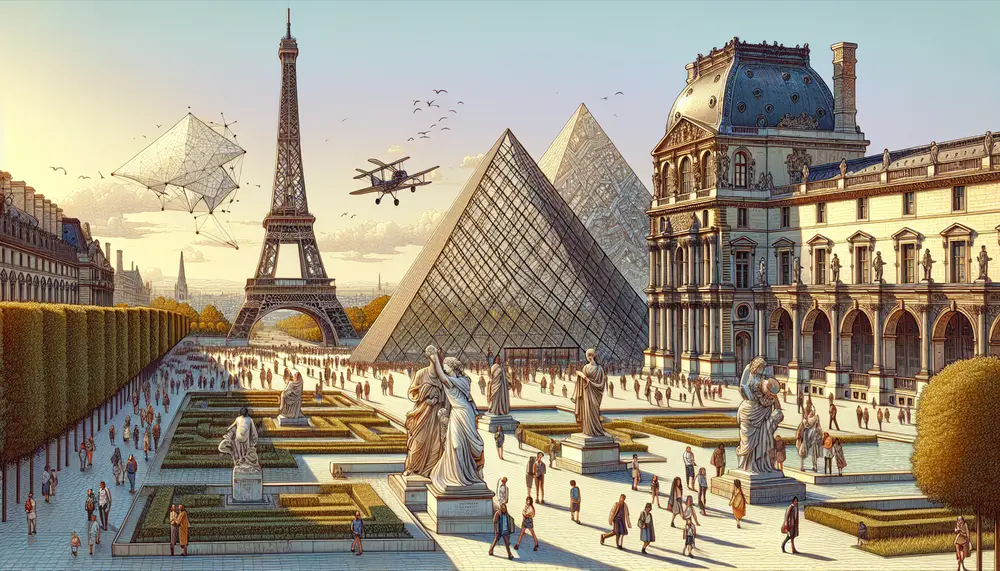
France holds more classified museums per capita than virtually any other nation, yet the way most visitors engage with them barely scratches the surface. The Louvre alone contains 380,000 objects, of which roughly 35,000 are on permanent display across 72,735 square meters of gallery space. Attempting to "see" it comprehensively in a single visit is not just inefficient — it's counterproductive. Experienced art travelers allocate two to three focused visits, each centered on a specific department: Egyptian Antiquities, the Richelieu Wing's French sculpture, or the Denon Wing's Italian paintings. This curatorial mindset transforms the experience entirely.
Structuring Your Museum Strategy: Thematic Depth Over Breadth
The most rewarding approach to France's major institutions is thematic rather than chronological. At the Musée d'Orsay, the Impressionist collections on the fifth floor draw predictable crowds to Monet and Renoir, but the real depth lies in the Naturalist and Symbolist works by Gustave Moreau, Puvis de Chavannes, and Odilon Redon on the middle level — artists whose influence on 20th-century art remains systematically undervalued. Similarly, the Centre Pompidou houses the largest collection of modern and contemporary art in Europe, with over 120,000 works, yet its rotating permanent collection means repeat visits consistently yield new material. For anyone serious about understanding the full arc of French visual culture from prehistory to the present, these three institutions form an essential triad.
Beyond Paris, the provincial museums are where genuine discovery happens. The Musée des Beaux-Arts in Lyon is France's second-largest fine arts collection, with particular strengths in Dutch Golden Age painting and Egyptian antiquities that rival many national institutions. In Lille, the Palais des Beaux-Arts holds one of Europe's finest collections of Flemish masters, including works by Rubens and van Dyck rarely reproduced in standard art histories. These institutions receive a fraction of the visitor numbers of their Parisian counterparts, which means direct, unhurried access to extraordinary works.
Specialized Collections and Hidden Institutional Strengths
France's specialized museums reward targeted visits in ways that encyclopedic collections cannot. The Musée de Cluny in Paris — formally the Musée National du Moyen Âge — offers the definitive experience of medieval decorative arts, anchored by the six-panel Lady and the Unicorn tapestries from around 1500. The Musée Rodin, operating within the sculptor's former residence at the Hôtel Biron, contextualizes the work with archival drawings and correspondence that fundamentally alter how you read the sculptures. For those tracing the connection between monumental French art and its historical context, the Musée de l'Armée at Les Invalides — containing Napoleon's tomb and 500,000 military artifacts — is indispensable.
- Book timed entries at least two weeks in advance for the Louvre and Orsay, especially between April and October
- Museum Pass holders skip ticket queues but not security lines — arrive before 9:30 AM regardless
- The Paris Musées network covers 14 municipal museums with free permanent collection access year-round
- Provincial museum free admission days (typically the first Sunday of each month) attract local rather than tourist crowds — ideal conditions for serious engagement
Understanding France's art institutions also means recognizing the DRAC system — the regional directorates that classify and fund heritage collections across all 18 administrative regions. This network explains why a mid-sized city like Strasbourg maintains the Musée de l'Œuvre Notre-Dame, housing medieval sculpture of international significance. The country's artistic heritage extends far beyond its famous landmarks, distributed through a deliberate institutional architecture that rewards those who engage with it systematically rather than opportunistically.
Pros and Cons of Exploring Art and History in France
| Pros | Cons |
|---|---|
| Rich cultural heritage with numerous UNESCO World Heritage Sites | Overcrowding at major tourist attractions, especially in peak season |
| Diverse range of museums showcasing both famous and lesser-known artworks | Potentially high costs for museum entry and guided tours |
| Accessibility to historic sites spanning from prehistoric to modern art | Difficulty navigating vast collections within large museums like the Louvre |
| Opportunity to engage in thematic exploration of art movements such as Impressionism and Cubism | Language barriers for non-French speakers in some regional areas |
| Abundance of regional art scenes that offer unique local insights | Time-consuming to plan a comprehensive itinerary covering multiple regions |
Impressionism, Cubism, and the French Avant-Garde: Global Art Movements Born in France
No country has shaped the trajectory of modern art more decisively than France. Between roughly 1860 and 1940, Paris functioned as the undisputed laboratory of Western visual culture — a place where rejected salon painters, émigré sculptors, and radical theorists collided to produce movements that permanently altered how humanity sees the world. Understanding these movements is not merely an art history exercise; it is essential context for anyone serious about engaging with France's cultural landscape on a deeper level.
Impressionism: The Revolution That Started With a Rejection Letter
The story begins with institutional failure. When the Paris Salon rejected works by Monet, Pissarro, Renoir, and their contemporaries in 1863, Napoleon III permitted the establishment of the Salon des Refusés — inadvertently creating a platform for what would become the most influential painting movement in history. The first official Impressionist exhibition followed in 1874, held in photographer Nadar's studio on Boulevard des Capucines. The name "Impressionism" itself originated as mockery: critic Louis Leroy seized on Monet's Impression, Sunrise to ridicule the entire group, and the painters adopted the insult as their badge of honor.
What made Impressionism genuinely radical was its methodological break with academic tradition. Painting en plein air, using broken brushstrokes and unmixed pigments to capture transient light conditions, these artists were essentially arguing that perception itself — not idealized form — was the legitimate subject of art. Monet's series paintings of Rouen Cathedral (1892–1894), depicting the same façade under 30 different lighting conditions, represent perhaps the most systematic exploration of this philosophy. When exploring the layered visual heritage that defines French culture, Impressionism consistently emerges as the hinge point between classical tradition and modernist experimentation.
Cubism and the Parisian Avant-Garde: Breaking the Picture Plane
If Impressionism fractured light, Cubism fractured form itself. Developed between 1907 and 1914 primarily by Pablo Picasso and Georges Braque working in Montmartre and Montparnasse, Cubism dismantled single-point perspective — a convention that had dominated European painting since Brunelleschi's 15th-century experiments. Picasso's Les Demoiselles d'Avignon (1907) is the canonical rupture point, though Braque's landscapes from L'Estaque that same year demonstrate the movement was genuinely collaborative.
The avant-garde ecosystem that sustained these movements deserves particular attention. Gertrude Stein's salon at 27 Rue de Fleurus, Ambroise Vollard's gallery on Rue Laffitte, and the cafés of Montparnasse created an infrastructure for artistic risk-taking that had no equivalent elsewhere. Fauvism (Matisse, Derain), Orphism (Delaunay), and Surrealism (Breton, Ernst, Dalí in his Paris years) all emerged from this same concentrated geography. Anyone seriously investigating the monumental achievements embedded in French artistic history will quickly discover how much of 20th-century global art traces directly back to a few arrondissements in Paris.
For visitors engaging with these movements today, the most productive approach combines institutional and neighborhood-level exploration:
- Musée d'Orsay holds the world's premier Impressionist collection — book timed entry at least 3 weeks in advance
- Centre Pompidou covers Cubism through Surrealism with exceptional depth, including Braque's studio materials
- Montmartre's Bateau-Lavoir (13 Place Émile Goudeau), where Picasso painted Les Demoiselles, remains visitable and contextually irreplaceable
- Musée de l'Orangerie houses Monet's monumental Nymphéas murals in the oval rooms he designed personally
The critical insight for serious art travelers is that these movements were geographically specific. The light of the Île-de-France, the density of Paris's intellectual community, and the French state's paradoxical combination of institutional conservatism and eventual patronage all shaped what was created. Seeing these works in situ — rather than in reproduction — remains a qualitatively different experience that no digital substitute has yet managed to replicate.
Gothic Cathedrals, Royal Châteaux, and the Architecture of French Power
French architecture is not merely a backdrop to history — it is history, encoded in stone, glass, and mortar. From the ribbed vaults of 12th-century cathedrals to the symmetrical grandeur of 17th-century royal palaces, every major building campaign in France was a deliberate act of political and theological communication. Understanding the architectural logic behind these structures transforms a visit from sightseeing into genuine historical literacy.
The Gothic Cathedral as Political Instrument
The Gothic style emerged not in the south of France but in the Île-de-France region around 1140, when Abbot Suger began rebuilding the Basilica of Saint-Denis. His core innovation — combining pointed arches, ribbed vaulting, and flying buttresses — allowed walls to become thinner and taller, flooding interiors with colored light. This was theology made structural: light symbolized divine presence, and height expressed the soul's aspiration toward God. Within a century, this formula had produced Notre-Dame de Paris (begun 1163), Chartres Cathedral (largely completed by 1220), and Reims Cathedral (begun 1211), the coronation church of French kings for over 600 years.
Chartres deserves particular attention from serious visitors. Its two surviving original rose windows date to around 1215 and represent the most complete medieval glazing program in existence — over 170 individual windows covering roughly 2,600 square meters of stained glass. The iconographic program moves from Old Testament narratives in the north transept to New Testament scenes in the south, creating a visual theological encyclopedia legible even to an illiterate medieval congregation. As you explore some of France's most significant artistic achievements, cathedrals like Chartres consistently demonstrate that medieval "religious art" and medieval "political art" were never separate categories.
Royal Châteaux and the Architecture of Absolute Power
If Gothic cathedrals expressed divine authority, the royal châteaux of the Loire Valley and Versailles expressed something more terrestrial — the unambiguous power of the French monarchy. The Loire Valley's concentration of royal residences, including Chambord, Chenonceau, and Amboise, reflects the late 15th and early 16th century period when French kings returned from Italian campaigns laden with Renaissance influences. Chambord alone contains 440 rooms, 365 fireplaces, and a double-helix staircase often attributed — almost certainly incorrectly, but persistently — to Leonardo da Vinci.
Versailles, however, represents the apex of architectural power-projection. Louis XIV relocated his court there permanently in 1682, transforming a hunting lodge into a palace complex covering over 67,000 square meters of interior space, surrounded by 800 hectares of formal gardens. Every detail — the Hall of Mirrors' 357 mirrors reflecting the garden façade, the strict hierarchy of apartment allocation, the king's bedroom positioned at the geometric center of the complex — was engineered to make Louis XIV's supremacy physically self-evident. When examining the deeper layers of France's built heritage, Versailles functions less as a palace than as a three-dimensional political manifesto.
For visitors planning serious architectural itineraries, a practical sequence matters:
- Saint-Denis Basilica first — to establish the Gothic origin point and study the royal necropolis
- Chartres for the fullest surviving Gothic interior experience, ideally on a clear morning when the west façade windows are backlit
- Chambord and Chenonceau to trace the Italian Renaissance absorption into French forms
- Versailles last — its logic only fully registers once you understand what it was deliberately superseding
This architectural sequence is precisely the kind of layered reading that distinguishes a structured historical journey through France from a checklist of famous buildings. As a chronological approach to French art and monuments consistently reveals, each structure was a response to what came before — and a statement about what its builders intended to come next.
Revolution, Empire, and Canvas: How Political Upheaval Shaped French Artistic Production
Few periods in Western history compressed as much political violence, ideological transformation, and cultural reinvention into as short a timespan as France between 1789 and 1815. Artists were not bystanders to these convulsions — they were active participants, propagandists, victims, and opportunists. Understanding this dynamic is essential for anyone serious about reading French art beyond surface aesthetics. The revolution didn't just change France's government; it fundamentally restructured who commissioned art, who consumed it, and what it was allowed to say.
The Revolutionary Iconoclasm and Its Artistic Consequences
When the Revolution dismantled the Ancien Régime, it simultaneously demolished the patronage infrastructure that had sustained French painting for over a century. The Royal Academy of Painting and Sculpture — founded in 1648 and the gatekeeper of official taste — was abolished in 1793. This created a paradoxical moment of creative liberation and economic catastrophe for working artists. Aristocratic collectors fled into exile, church commissions evaporated, and the Salon, now open to all artists rather than restricted to academicians, exploded in scale: submissions jumped from around 350 works in 1789 to over 700 by 1795.
Jacques-Louis David navigated this turbulence with extraordinary political cunning. His 1793 painting The Death of Marat — depicting the murdered revolutionary journalist in a pose deliberately echoing Renaissance pietà compositions — exemplifies how revolutionary art fused secular politics with quasi-religious iconography. David served as de facto art dictator for the Jacobin government, organizing massive public festivals designed to replace Catholic ritual with republican ceremony. Artists who couldn't adapt to this new ideological demand found themselves not merely unemployed but potentially accused of counter-revolutionary sympathies.
Napoleon's Calculated Aesthetic Program
Napoleon understood visual culture as a geopolitical instrument with the same clarity a modern communications director understands media strategy. He systematically deployed art to legitimize a regime that had no hereditary claim to power. The numbers alone reveal the ambition: between 1804 and 1814, the Louvre — renamed the Musée Napoléon — displayed over 5,000 works looted from conquered territories across Europe and Egypt. For those exploring France's greatest artistic repositories from prehistory to the present, grasping this imperial collecting logic transforms how the Louvre's encyclopedic holdings feel today.
David's The Coronation of Napoleon (1805–1807), measuring 9.79 × 6.21 meters, required three years of work and depicted over 200 recognizable figures — a bureaucratic masterwork of flattery as much as painting. Napoleon demanded himself shown crowning Joséphine rather than receiving the crown from Pope Pius VII, a compositional choice that encoded an entire theory of sovereign power. Antoine-Jean Gros extended this program with battlefield paintings like Napoleon Visiting the Plague-Stricken at Jaffa (1804), portraying the general with the healing touch traditionally attributed to French kings — Romantic heroism pressed into dynastic service.
What distinguishes this era for serious students of French culture is the complete fusion of aesthetic and political intention. The monuments, paintings, and public sculptures commissioned between 1789 and 1815 weren't decoration — they were arguments. Visitors who approach the iconic works and landmarks that define France's visual heritage with this political literacy will read layers of meaning that purely aesthetic frameworks miss entirely. Every compositional choice, every iconographic reference, every scale decision carried ideological weight that contemporary viewers decoded instinctively.
- Key works to examine closely: David's Oath of the Horatii (1784) as pre-revolutionary priming; Gros's Napoleonic battle series; Prud'hon's allegorical portraits of Joséphine
- Essential context: The dissolution of guild structures freed artists technically while creating new forms of state dependency
- Practical viewing tip: At the Louvre, compare the Grande Galerie's hanging logic with the imperial acquisition records — the gaps where restituted works once hung remain quietly instructive
Regional Art Landscapes: From Provençal Light to Breton Folklore and Alsatian Heritage
France's artistic identity is never monolithic. Each region has developed its own visual language, shaped by geography, migration, trade routes, and deeply rooted local traditions. Travelers who treat France as a single cultural block miss the point entirely — the contrast between the sun-bleached ochres of Luberon villages and the storm-grey granite coastlines of Finistère represents not just a change in scenery, but a fundamentally different artistic worldview. Understanding these regional distinctions transforms a standard cultural tour into something far more rewarding.
Provence: Where Light Became the Subject
The Provence region produced one of the most consequential shifts in Western painting. When Paul Cézanne returned obsessively to Mont Sainte-Victoire — he painted it over 80 times between 1882 and 1906 — he wasn't simply documenting a mountain. He was interrogating how light dissolves solid form, laying the groundwork for Cubism. Van Gogh arrived in Arles in February 1888 and produced roughly 300 works in just 15 months, driven by the region's extraordinary luminosity and color saturation. Today, the Fondation Vasarely in Aix-en-Provence and the Musée de l'Arles Antique anchor a regional art circuit that connects ancient Roman mosaics to 20th-century optical art within a 60-kilometer radius.
The practical advice here: visit the Luberon and the Alpilles in early morning or late afternoon light, not midday. The same quality of light that obsessed Cézanne genuinely behaves differently at those hours — shadows acquire violet undertones that photographs rarely capture. Booking the layered visual history of southern France into a focused three-day itinerary around Aix, Arles, and Les Baux-de-Provence gives sufficient depth without oversaturation.
Brittany and Alsace: Folklore, Symbolism, and Cultural Duality
Brittany operates on a completely different artistic register. The Pont-Aven School, where Gauguin worked between 1886 and 1890 alongside Émile Bernard, developed Synthetism — bold outlines, flat color planes, and an embrace of local Breton religious and peasant culture as valid artistic subject matter. The Musée de Pont-Aven houses over 2,000 works documenting this pivotal movement, and the surrounding landscape remains largely unchanged. Breton folk art, particularly decorated furniture from the Bigouden region and the carved stone calvaries of the Enclos Paroissiaux — with Guimiliau's dating to 1581 featuring over 200 figures — represents a visual tradition entirely independent of Parisian influence.
Alsace presents yet another complexity: a region that changed national hands four times between 1871 and 1945, producing an art heritage that draws equally from German Romanticism and French Classicism. The Unterlinden Museum in Colmar holds Matthias Grünewald's Isenheim Altarpiece (completed c. 1515), arguably the most psychologically intense work of Northern European religious art ever produced. The triptych's depiction of Christ's tortured body was specifically designed to comfort plague victims — context that rewrites how you read every brushstroke.
For those building a comprehensive understanding of France's artistic geography from prehistoric caves to modern institutions, these regional scenes aren't sideshows — they're the substance. The regional folk museum network, including the Écomusée d'Alsace near Ungersheim with 70 reconstructed historic buildings, consistently outperforms major urban museums in visitor satisfaction for those specifically interested in material culture and craft traditions.
- Pont-Aven Museum: essential for Post-Impressionism outside Paris, smaller crowds, deep archival access
- Enclos Paroissiaux circuit: seven major parish closes in northern Finistère, best covered by car over two days
- Isenheim Altarpiece: arrive at Colmar's Unterlinden when it opens at 9am — the altarpiece room fills quickly
- Cézanne's studio (Aix-en-Provence): his original objects and tools remain in situ, offering rare unmediated proximity to a working artistic process
Anyone serious about connecting France's great monuments to their deeper artistic traditions will find the regions reward patience. Spending four days in Alsace or Brittany over a single day in each often yields proportionally more insight — these are places where local knowledge, whether from a museum curator or a calvary guide, consistently unlocks meaning that guidebooks simply cannot deliver.
Fashion, Literature, and Decorative Arts: The Broader Cultural Fabric of French Creativity
France's cultural dominance extends far beyond paint on canvas or stone carved into monuments. The country has systematically positioned itself as the global arbiter of taste across multiple creative disciplines simultaneously — a phenomenon with no real parallel in any other nation. When you examine French creativity seriously, you quickly realize that fashion, literature, and decorative arts are not separate industries but interconnected expressions of a single, deeply held national philosophy: that beauty and intellectual rigor belong together.
Haute Couture and the Architecture of Clothing
Paris has hosted the official Haute Couture calendar since 1945, but the city's grip on fashion begins much earlier. Charles Frederick Worth established the first true couture house in Paris in 1858, essentially inventing the concept of the fashion designer as creative authority. Today, the Fédération de la Haute Couture et de la Mode recognizes only around 15 official Haute Couture houses — a deliberately restricted club that preserves extraordinary standards: each garment requires a minimum of 700 hours of hand-stitching. The Palais Galliera in Paris holds over 200,000 objects documenting this history, making it arguably the world's most important fashion archive. For serious visitors, the permanent collection alone justifies a dedicated half-day visit.
What makes French fashion culturally significant — rather than merely commercially successful — is its deep conversation with the visual arts. Yves Saint Laurent's Mondrian dress (1965) translated geometric abstraction into wearable form. Elsa Schiaparelli collaborated directly with Salvador Dalí. These weren't marketing exercises; they were genuine intellectual partnerships that reshaped both fields. Understanding this cross-pollination is essential for anyone exploring French artistic heritage and the broader landmarks and traditions that shaped French visual culture across centuries.
Literature, Salons, and the Power of Ideas
France produced 16 Nobel Prize laureates in Literature — more than any other country. But raw numbers undersell the structural role French literature played in organizing public intellectual life. The salon culture of the 17th and 18th centuries, hosted primarily by educated women like Madame de Rambouillet and later Madame du Deffand, functioned as a parallel academy where philosophy, science, and aesthetics were debated simultaneously. Voltaire, Diderot, and Rousseau refined their ideas in these spaces before those ideas dismantled monarchies.
The decorative arts complete this picture. Sèvres porcelain, established as a royal manufactory in 1756, produced objects that were simultaneously diplomatic tools and aesthetic manifestos — Louis XV dispatched Sèvres pieces as state gifts precisely because they communicated French supremacy in refined taste. The Gobelins tapestry workshops, operating since 1662, used the same logic: technical perfection as soft power. Visitors to the Mobilier National can still tour active Gobelins workshops in Paris, observing weavers working on multi-year commissions using techniques virtually unchanged since the 17th century.
For anyone building a serious understanding of how France's greatest artistic achievements connect to its historical identity, these applied arts deserve equal attention alongside painting and sculpture. The distinction between fine and decorative arts was itself largely a French invention — and one the French periodically enjoyed dismantling.
- Palais Galliera — essential for fashion history; check temporary exhibitions before visiting
- Musée des Arts Décoratifs — 150,000 objects spanning furniture, ceramics, glass, and jewelry from medieval to contemporary
- Gobelins Manufactory — guided tours available Tuesday through Thursday; book at least three weeks in advance
- Bibliothèque nationale de France — holds first editions of Molière, Flaubert, and Proust; reading room access requires accreditation
Preserving and Experiencing French Heritage: Museums, UNESCO Sites, and Cultural Tourism Strategies
France holds 52 UNESCO World Heritage Sites as of 2024, placing it among the top five countries globally by inscription count. Yet the sheer volume of protected sites masks a more complex reality: preservation, funding, and visitor management are ongoing battles fought daily by heritage institutions, regional governments, and private foundations. Understanding how this system operates gives culturally motivated travelers a decisive advantage in planning meaningful, depth-first itineraries rather than surface-level monument checklists.
The Institutional Architecture of French Heritage Protection
The French state classifies heritage through two legal tiers: Monument Historique Classé (fully protected) and Monument Historique Inscrit (registered for surveillance). More than 43,000 structures fall under one category or the other, managed through the Ministère de la Culture in coordination with regional Directions Régionales des Affaires Culturelles (DRAC). Restoration funding typically follows a 50/50 split between state contributions and local or private sources — a model that increasingly leans on philanthropic partnerships like the Fondation du Patrimoine, which has co-financed over 30,000 projects since its 1996 founding. Notre-Dame de Paris demonstrated the full weight of this system: the €700 million restoration drew contributions from 340,000 donors across 150 countries, setting a global benchmark for emergency heritage fundraising.
For those tracing the full arc of French creativity from prehistoric caves to world-class museums, understanding these institutional layers helps decode why some sites offer immersive digital reconstructions while others remain deliberately austere. Lascaux IV, the fourth-generation replica complex opened in 2016 for €57 million, represents the highest current standard in experiential heritage: the original cave is permanently closed to prevent CO₂ damage, while the replica delivers archaeologically accurate facsimiles using robotic milling and hand-applied mineral pigments.
Strategic Visitor Approaches for High-Density Heritage Zones
The Île-de-France region alone concentrates roughly 30% of France's most-visited heritage institutions, creating chronic overcrowding that actively degrades the visitor experience at flagship sites. The Louvre recorded 8.9 million visitors in 2023; without pre-booked timed entry slots, queue times at the Richelieu wing regularly exceed 90 minutes. Experienced cultural travelers apply a consistent counter-strategy:
- Book first-entry slots (9:00–10:00 AM) at major museums at least three weeks in advance during high season (June–September)
- Use the Paris Museum Pass primarily for medium-tier institutions like Musée de Cluny or Musée Jacquemart-André, where it eliminates queues almost entirely
- Prioritize Tuesday and Wednesday mornings for sites outside Paris — regional museums see 40–60% lower footfall mid-week
- Engage licensed guides holding the Carte Professionnelle, which certifies deep subject-matter training across specific regions or periods
The richest heritage experiences often emerge away from the headline sites. As explored when tracing France's lesser-known artistic landmarks across its diverse regions, areas like the Dordogne Valley, the Burgundy wine route, and the Cathar corridor in Languedoc offer UNESCO-protected sites with minimal tourist infrastructure — meaning genuine access to context, silence, and local expertise. The Vezère Valley, inscribed in 1979, contains 147 prehistoric sites and 25 decorated caves, yet receives a fraction of the visitor pressure absorbed by a single Paris arrondissement.
Digital tools are reshaping heritage engagement at every level. The Centre des Monuments Nationaux now offers augmented reality overlays at 17 sites, while the Réunion des Musées Nationaux provides open-access digital collections exceeding 300,000 high-resolution works. For those building a serious engagement with the full depth of French art and monumental history, combining on-site visits with curated digital preparation — using INHA research databases, regional museum catalogues, and official heritage registers — transforms individual stops into chapters of a coherent cultural narrative rather than disconnected photo opportunities.
FAQ about Art & History in France
What are the key periods in French art history?
Key periods in French art history include Prehistoric, Romanesque, Gothic, Renaissance, Baroque, and Modern art movements like Impressionism and Cubism.
Why is the Louvre considered a premier art institution?
The Louvre houses approximately 380,000 works spanning over 9,000 years of civilization, making it a vital repository of art and culture.
What impact did the French Revolution have on the arts?
The French Revolution transformed the art landscape by breaking traditional patronage systems, allowing artists more freedom, and creating new social-political themes in their work.
How does French regional art differ from national trends?
French regional art reflects local traditions, geographies, and histories, resulting in diverse artistic expressions that differ from dominant national movements.
What is the significance of France's UNESCO World Heritage Sites?
France's UNESCO World Heritage Sites highlight its rich cultural heritage, showcasing the nation's historical significance, architectural marvels, and artistic achievements.